
Catchment highlighted: Every few months a catchment is introduced
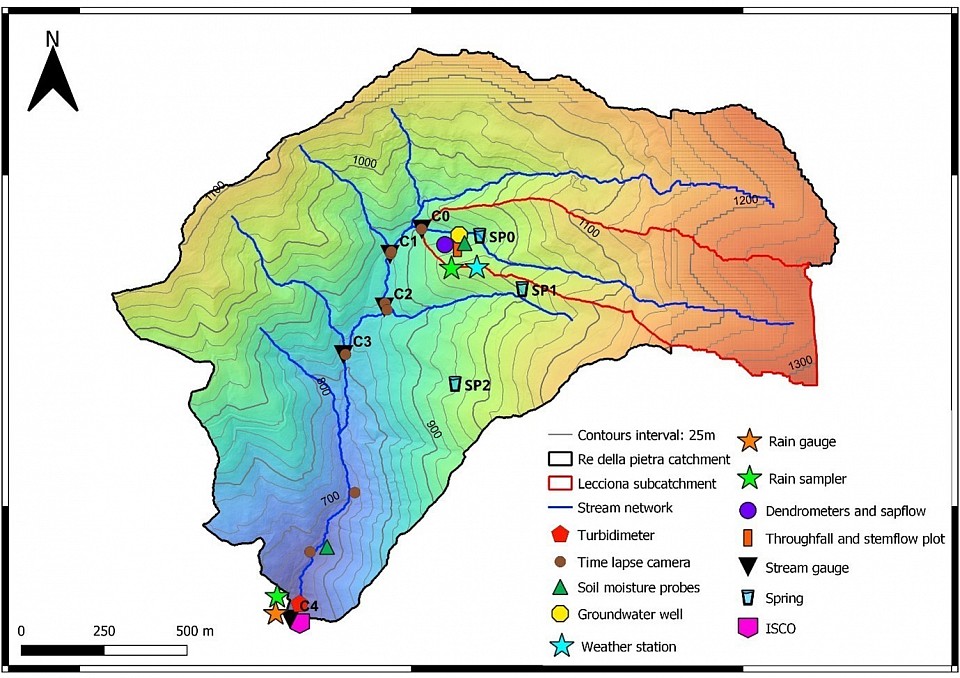
Map of the Re della Pietra catchment
EXPERIMENTAL BASIN: Re della Pietra
This experimental basin is located in Italy.
Contact person: Daniele Penna (mail: [email protected])
Link to the website of the catchment:
https://danielepenna.wixsite.com/redellapietra
Description of the basin
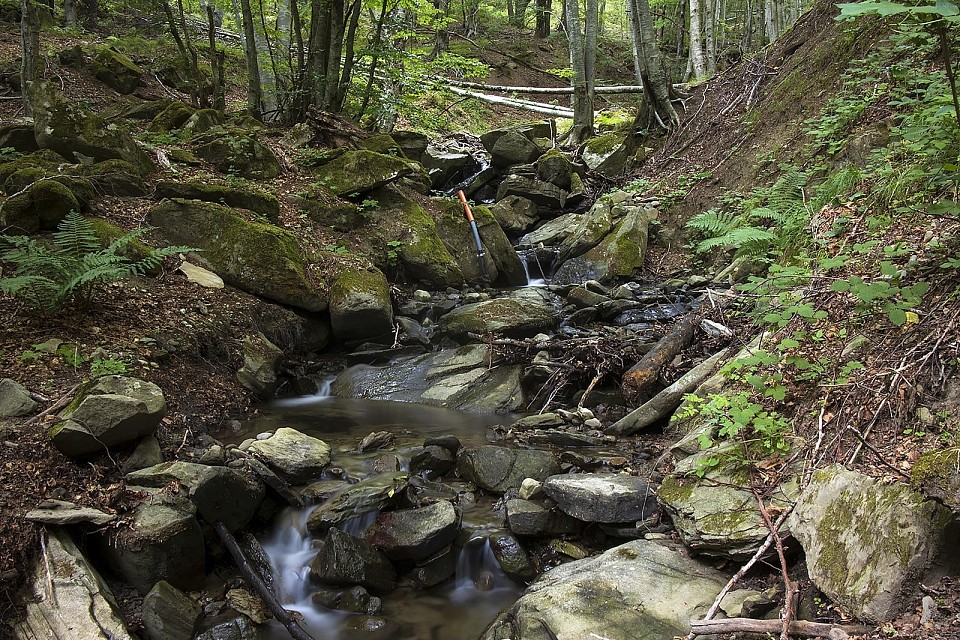
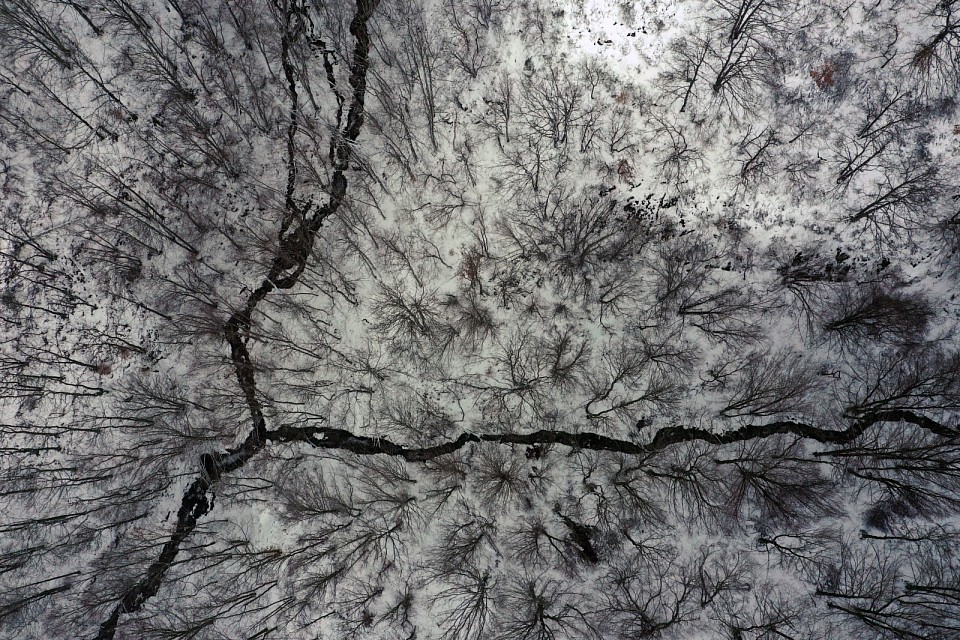
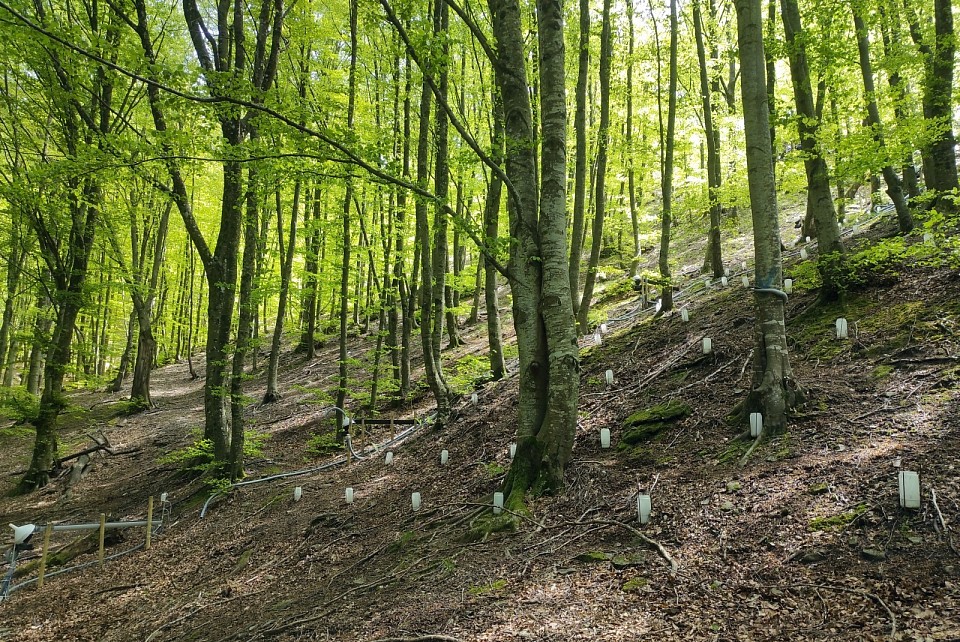
The Re della Pietra is a 2 km2 experimental forested catchment located in the Tuscan Apennines, Central Italy. The climate is temperate Mediterranean with wet (October–May) and dry (June–September) periods. The average annual precipitation depth is 1300 mm. Average monthly temperatures vary from 2 °C in January to 20 °C in August, and the average annual temperature is 10.5 °C. Elevations range from 634 to 1320 m a.s.l., the average slope is 27.5°, and the stream channel is approximately 3 km long. The catchment geology consists of sandstones corresponding to the Late Oligocene – Early Miocene Macigno Formation. The soil is well drained and typically deeper than 50–80 cm. Sand content ranged between 57 and 76 %, and clay content between 4 and 11 %. Soil texture is sandy loam, according to the USDA (1999) classification. The catchment area is predominantly covered by forests (>95 %), dominated by beech trees (Fagus sylvatica), oaks (Quercus cerris), and conifers (Pseudotsuga menziesii and Pinus nigra).
The Re della Pietra experimental catchment serves as a vital outdoor laboratory for advancing hydrological, ecohydrological, and ecophysiological research in a Mediterranean mountain environment. Recent studies have demonstrated that preferential flow and streamflow generation are primarily influenced by soil moisture, bulk density, and rainfall patterns (Kaffas et al., 2025; Macchioli Grande et al., 2024). Hillslope topography and stand structure influence throughfall variability and beech tree water use, with upslope trees experiencing greater water stress compared to those in riparian areas (Verdone et al., 2025; Fabiani et al., 2024). Integrating hydrological and ecophysiological perspectives is crucial for understanding feedbacks between hydro-climatic forcings and tree water fluxes (Cocozza & Penna, 2022; Murgia et al., in preparation). Ongoing studies further explore the role of soil moisture in sap flow and topographic controls on tree drought responses (Verdone et al., submitted), highlighting Re della Pietra’s value for interdisciplinary ecohydrological research (Penna, 2025)
Currently, the site is equipped with:
- Two weather station which record data about rainfall, air temperature, relative humidity, solar radiation, vapor pressure, wind speed, wind direction from 2018 and 2020.
- Stream gauges at three sections on the main stream (C1, C3 and C4 on the Re della Pietra) and one at the outlet of the Lecciona subcatchment which record about water stage, water temperature, and electrical conductivity from 2020 and 2021
- 12 soil moisture sensors along a transect in the north facing hillslope of the Lecciona subcatchment (6 probes that record from 2019) and along a transect in the west facing hillslope of the RdP catchment, close to the outlet (6 probes that record from 2021)
- Three groundwater wells that record groundwater level from 2021
- Two automatic stemflow sensors that record from 2024
- A yearly-variable number of sapflow sensors
- A throughfall plot formed by 87 manual samplers and 12 automatic gauges
- 11 time-lapse camera for monitoring stream morphological dynamics
- A turbidimeter (at C4) that record suspended sediment concentration from 2024
- An automatic water sampler (ISCO) at C4 from 2025
Since 2019, water samples have been collected for isotope (2H and 18O) composition and electrical conductivity from:
- Precipitation at two different elevations
- Throughfall in two locations
- Streams at four different sections
- Three springs
- Soil at different depths at three locations
- Wood cores of beech trees
References:
Cocozza, C., & Penna, D. (2022). Towards a more active dialogue between hydrologists and ecophysiologists for interdisciplinary studies in forest ecosystems. Science of The Total Environment, 807, 150877. https://doi.org/10.1016/j.scitotenv.2021.150877
Fabiani, G., Klaus, J., and Penna, D.: The influence of hillslope topography on beech water use: a comparative study in two different climates, Hydrol. Earth Syst. Sci., 28, 2683–2703, https://doi.org/10.5194/hess-28-2683-2024, 2024.
Kaffas, K., Murgia, I., Menapace, A., Macchioli Grande, M., Verdone, M., Dani, A., Manca di Villahermosa, F., Preti, F., Segura, C., Massari, C., Klaus, J., Borga, M., & Penna, D. (2025). Controls on preferential flow and its role on streamflow generation in a Mediterranean forested catchment. Journal of Hydrology, 660, 133469. https://doi.org/10.1016/j.jhydrol.2025.133469
Macchioli Grande, M., Kaffas, K., Verdone, M., Borga, M., Cocozza, C., Dani, A., Errico, A., Fabiani, G., Gourdol, L., Klaus, J., Manca di Villahermosa, F., Massari, C., Murgia, I., Pfister, L., Preti, F., Segura, C., Tailliez, C., Trucchi, P., Zuecco, G., . . . Penna, D. (2024). Seasonal meteorological forcing controls runoff generation at multiple scales in a Mediterranean forested mountain catchment. Journal of Hydrology, 639, 131642. https://doi.org/10.1016/j.jhydrol.2024.131642
Penna, D. (2025). Climate and landscape drive catchment hydrological processes at the global scale. Nature Water, 3(4), 372-373. https://doi.org/10.1038/s44221-025-00411-0
Verdone, M., Van Meerveld, I., Massari, C., & Penna, D. (2025). Variability and temporal stability of throughfall along a hillslope. Journal of Hydrology, 647, 132294. https://doi.org/10.1016/j.jhydrol.2024.132294
